
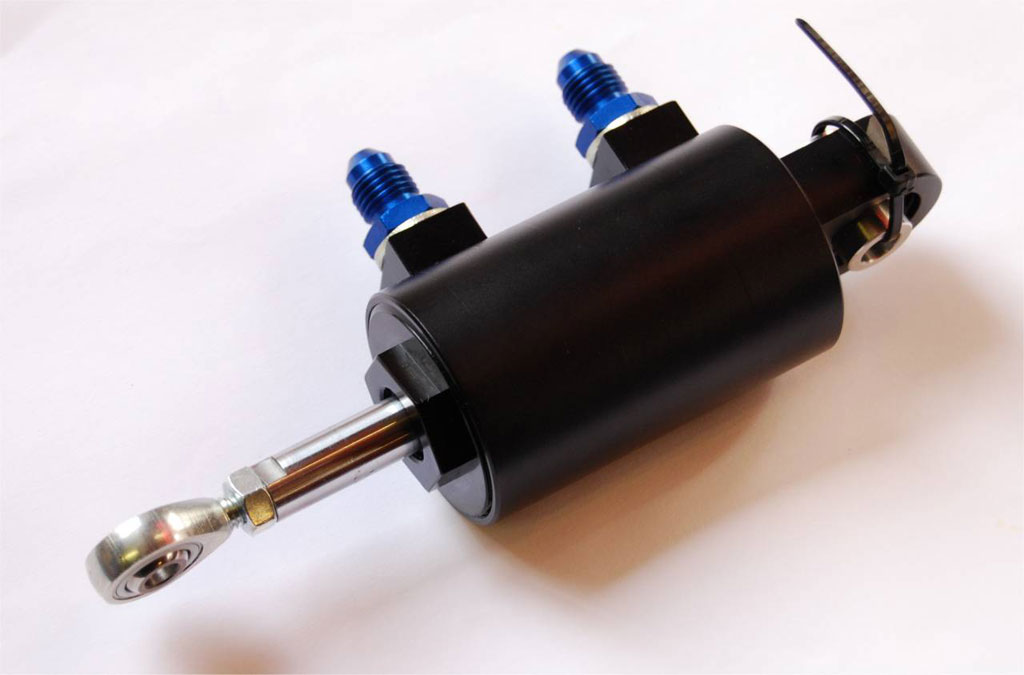
Advantages of pneumatic over electric solenoid

With only one exception, that being Zytek's excellent EGS, all serious aftermarket paddleshift systems are operated by compressed air actuators and not by crude 12v electric solenoids. Have you ever wondered why? Well, there are plenty of very good reasons, as detailed below:

1. Air actuators are considerably smaller and are thus easy to mount without comprimising other areas of the car. By contrast, solenoids have a very poor power density, which means that in order to produce sufficient force, they need to be made very large and heavy. This often means that the solenoid will not physically fit in the space available without the need to change other areas of the car design. There is also no other option but to place the extra weight of the solenoid at the point where it is most unwanted!

2. Air actuators produce considerably more force for considerably less size & weight. The Geartronics actuator produces approximately 70Kg force when operated at 8.5bar (125psi). By comparison, a 3" (75mm) diameter solenoid with perhaps 200 turns of heavy copper wire will only produce about 35-40Kg force - when cold...

3. Air actuators do not suffer a reduction in force when the temperature rises. When the copper wire in a solenoid gets hot, its resistance increases, and so the power reduces. At 100 degrees Celsius, the force will reduce by approximately 25%. This often makes the difference between the system working or not.

4. Air actuators do not cause voltage drop-outs that can lead to malfunctions in other electrical systems. You don't get anything for nothing, and to produce sufficient force, the solenoid must consume a large amount of power. A solenod large enough to produce the required force will draw a large current from the vehicle electrical system. The situation is even worse when a solenoid is first energised because of what is called the in-rush current. This massive initial current effectively presents a momentary short-circuit across the battery & alternator, which in turn can cause other systems to malfunction. A compressed air system takes only a small amount of power from the electrical system over a longer period of time, so the transient demand on the electrical system is far less.

5. Air actuators don't produce electro-magnetic interference which can adversely affect other electronic systems. When high-powered solenoids are turned on and off, they generate electrical interference which may cause sensitive electronic equipment to malfunction.

6. Air actuators do not require high current cables and control units. High-powered solenoids require heavy cables to deliver the very high current that is drawn from the electrical system. So high in fact, that we have been made aware of several instances of one of our competitors systems actually catching fire, presumably caused by inferior or incorrect specification materials.

7. Air actuators provide a 'cushion' of compressed air, which means they are naturally compliant and are easy on the shift mechanism. By contrast, the heavy armature (plunger) of a solenoid, moving at high speed, can impose excessive shock loadings on the shift mechanism. Solenoids have often been described as "vicious" in operation.

8. Air actuators do not generate heat - in fact, the flow of air produces a slight cooling effect. As mentioned in point 3, the power of a solenoid dramatically reduces when it gets hot. Not only does the solenoid's temperature increase with the searing heat of a racing car, it also generates it's own internal heat, thus compounding the problem. The Geartronics pneumatic actuator is constructed using Viton seals and a PEEK piston and bearing, it can therefor operate constantly at temperatures in excess of 230 degrees Celsius, long after a solenoid has failed completely!

As mentioned at the top of this page, the only solenoid system that we are aware of that actually works reliably is the one manufactured by Zytek Engineering. This can in no way be compared to other solenoid systems on the market for several reasons. The Zytek system uses high efficiency high-voltage solenoids, and their GCU stores the required shift energy, rather than taking it all in one go from the electrical system. The Zytek shift strategy, in common with that used by Geartronics, is highly sophisticated. So sophisticated in fact, that the majority of other suppliers just don't understand how far behind they are!

So, in summary, if you are looking for an aftermarket shift system that is fast, reliable, consistent and affordable, then you really only have one choice - Geartronics.